


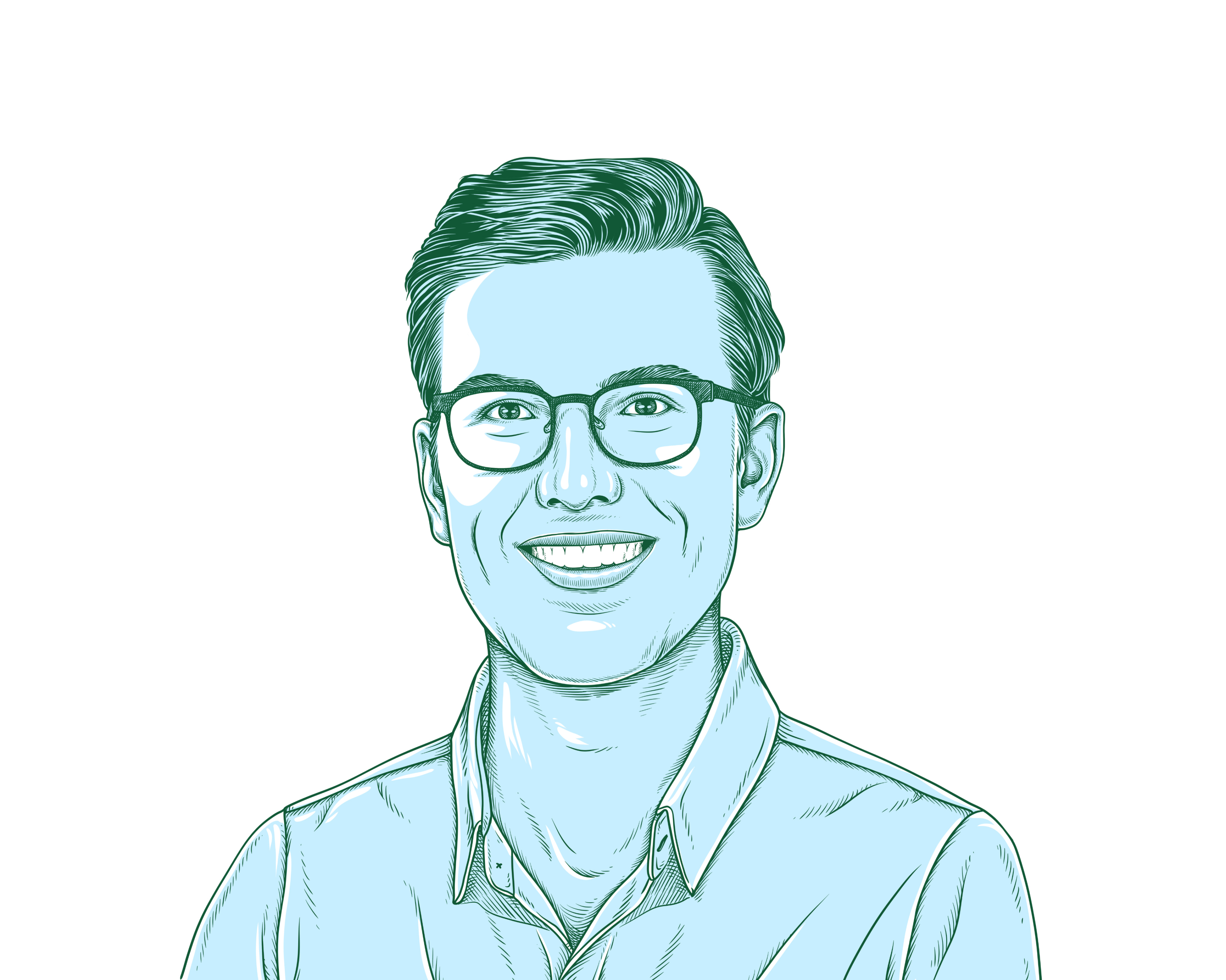
Matt Stone (GitHub) joined Fulcrum Genomics in September 2023. His professional expertise spans a diverse range of biological contexts, including immunotherapy, spatial and single-cell transcriptomics, and structural variant discovery. We recently sat down to chat about work and life as a bioinformatics consultant.
What’s your area of expertise, and what excites you about your work?
Matt: I embrace diving deep on both the computational and biology sides of a project, and I care about building software that is well grounded in biology and motivated by a business need. Building breadth in my expertise allows me to speak both languages and act effectively as the bridge between computational and lab teams. I bring a strong sense of product mindedness to my client projects, and I believe in letting data drive our development. The data doesn’t lie, and working with the stakeholders is the only real way to know if a pipeline is actually solving their problem.
I’m always excited by the chance to work with a client on a new assay or experiment. It’s rewarding to finally reach the moment a client lights up at a new result, and having the chance to reflect that excitement back. I’m also excited by opportunities to improve our open source software and internal engineering practices. I love learning about a better way to be doing something.
What’s a common challenge in our industry that people don’t talk about enough?
Getting lab and computational teams to talk with each other effectively.
I’ve noticed this can be made worse by imbalanced expectations for in-person work. Obviously, bench scientists have to be in-person, while the computational team may be hybrid or fully remote. I’ve worked in settings where this created a sense of “othering” between the two teams, so I made sure to be on site 2-3 days a week and always for team meetings. Without these interactions, you miss out on the opportunity to have unplanned conversations from which good ideas can spring.
It’s really about finding ways to meet people where they’re at, and being the person to connect the teams and connect the dots. At Fulcrum, this is balancing several different chat clients; in previous environments this was making sure I was on the ground to talk to scientists who had better things to do at the bench than check Slack. Good science doesn’t happen in silos.
And nothing is better than a whiteboard for unblocking a project.
What’s one tool, tip, or mindset shift that has made a big impact in your work?
Scale effort to the context. Don’t reinvent or overcomplicate the wheel, and also make it really easy to build good wheels.
I do most of my work in Python, where my rule of thumb is to optimize for developer time, not CPU time. At Fulcrum, we rely heavily on strict type checking to catch avoidable bugs early. I’ve worked with Clint (Valentine) to develop an internal Python package template so it’s trivially easy to stand up a new project with our recommended configuration. We want the default bar to be high, and we never want a developer to opt out of type checking or unit tests because setup is too much overhead. When we talk about scaling effort to context, we want folks to think about bigger picture concerns, like how thoroughly the code needs to be tested. Is a happy path okay, or do we need robust coverage? And the same goes for refactoring, containerization, or general productionization.
What’s a recent project or insight you’re particularly proud of?
Recently I was brought in to get a stalled project back on track - a workflow port from Snakemake to Nextflow that had grown beyond its original scope. The client had a critical dataset arriving in November and needed the pipeline ready. I managed three other engineers on the project, made calls about where to refactor versus where to work around existing patterns, and handled code review. A lot of my role was triaging - what do we fix properly, what do we patch, what do we leave alone to hit the deadline. We reached code completion in about two months, then discovered the new workflow wasn’t producing results consistent with the legacy pipeline. I set up a weekly iteration cycle: run the old pipeline, diagnose differences, implement patches, repeat. After about a month of that disciplined process, the ported workflow is now validated against legacy results, and we’re on track for the new dataset.
If you could give biotech startups one piece of advice, what would it be?
Good software engineering practices complement good lab work.
I think it’s easy to perceive testing, code review, and documentation as “nice to have”, but they’re just as necessary as detailed SOPs, lab journals, and disciplined LIMS provenance. Biotech isn’t Silicon Valley - we can’t just move fast and break things.
What’s something outside of work that inspires how you think about problem-solving?
Having a child has reshaped how I think about time. Before I had the flexibility to follow interesting tangents and didn’t worry too much about how long something might take because I could always make up the time later. But now time has become much more zero-sum and that’s made me more deliberate. I’m more mindful about where I invest my energy, and I’ve become better at identifying what really matters. I’m a perfectionist by nature and I’ve gotten better at saying “this is good enough for now and for its purpose.”
Fulcrum Genomics is a bioinformatics consulting firm built by scientists at the forefront of large-scale genomic research, with deep expertise in sequencing technology, pipeline engineering, and genomic data analysis for biotech, pharma, and academia. Engage us through project-based work, fractional R&D, or hourly consulting. Contact us to discuss your project.