

It is used because it works. It is used because thousands of pipelines were built around it. It is used because changing an aligner is never a casual decision when the output feeds variant calling, methylation profiling, clinical workflows, large research studies, and production-scale analysis.
That kind of staying power is a credit to the original tool. It also creates a familiar problem in bioinformatics: once a tool becomes standard, the field starts treating its limitations as part of the landscape.
Tim Fennell recently wrote about this in Bioinformatics Still (Mostly) Runs on Old Plumbing. A lot of useful work in genomics happens below the visible layer of new assays and new methods, in the libraries, file formats, utilities, and command-line tools that carry the everyday workload. When those tools get faster or more reliable, the benefit spreads across many workflows at once.
The new preprint from Heng Li and Fulcrum Genomics’ Nils Homer is a concrete example of that argument.
Minibwa takes on one of the most widely used pieces of genomic infrastructure: read alignment.
Moving past strict compatibility
A lot of recent work on BWA-MEM has focused on acceleration while preserving BWA-MEM-like behavior. BWA-MEM2 improved performance. BWA-MEME, BWA-MEM3, GPU implementations, and other efforts have pushed the limits of the approach.
That work is valuable, but strict compatibility creates a ceiling. If a tool has to stay close to BWA-MEM by design, there are only so many algorithmic changes and code optimizations it can make.
Minibwa takes a different approach. It does not try to be a bit-identical replacement for BWA-MEM. It keeps pieces that still make sense, including BWA-MEM-style variable-length seeding, but combines them with newer approaches from minimap2 and ropebwt3.
The result is a mapper designed for standard WGS short reads, Hi-C reads, accurate long reads, and directional bisulfite sequencing data.
In practical terms, minibwa introduces:
a faster batched SMEM-finding algorithm
minimap2-style chaining adapted for variable-length seeds
SIMD-based base alignment
more frequent use of ungapped fast paths
reduced effort in highly repetitive regions where short reads are unlikely to be placed accurately
native support for directional bisulfite sequencing
That last point is worth calling out. BWA-Meth made bisulfite alignment practical by wrapping BWA-MEM. BISCUIT went deeper by modifying the BWA-MEM source code. Minibwa brings bisulfite-aware mapping into a faster framework rather than treating it as a layer bolted onto older assumptions.
The speedup is substantial
The headline result is speed.
In the reported benchmarks, minibwa is about four times as fast as BWA-MEM and more than twice as fast as BWA-MEM2 for standard WGS short-read alignment, while maintaining comparable accuracy. For long-read data, it is slightly faster than minimap2 in the reported tests. For bisulfite sequencing, it is several times faster than BWA-Meth and BISCUIT, and more than 10 times faster than Bismark.
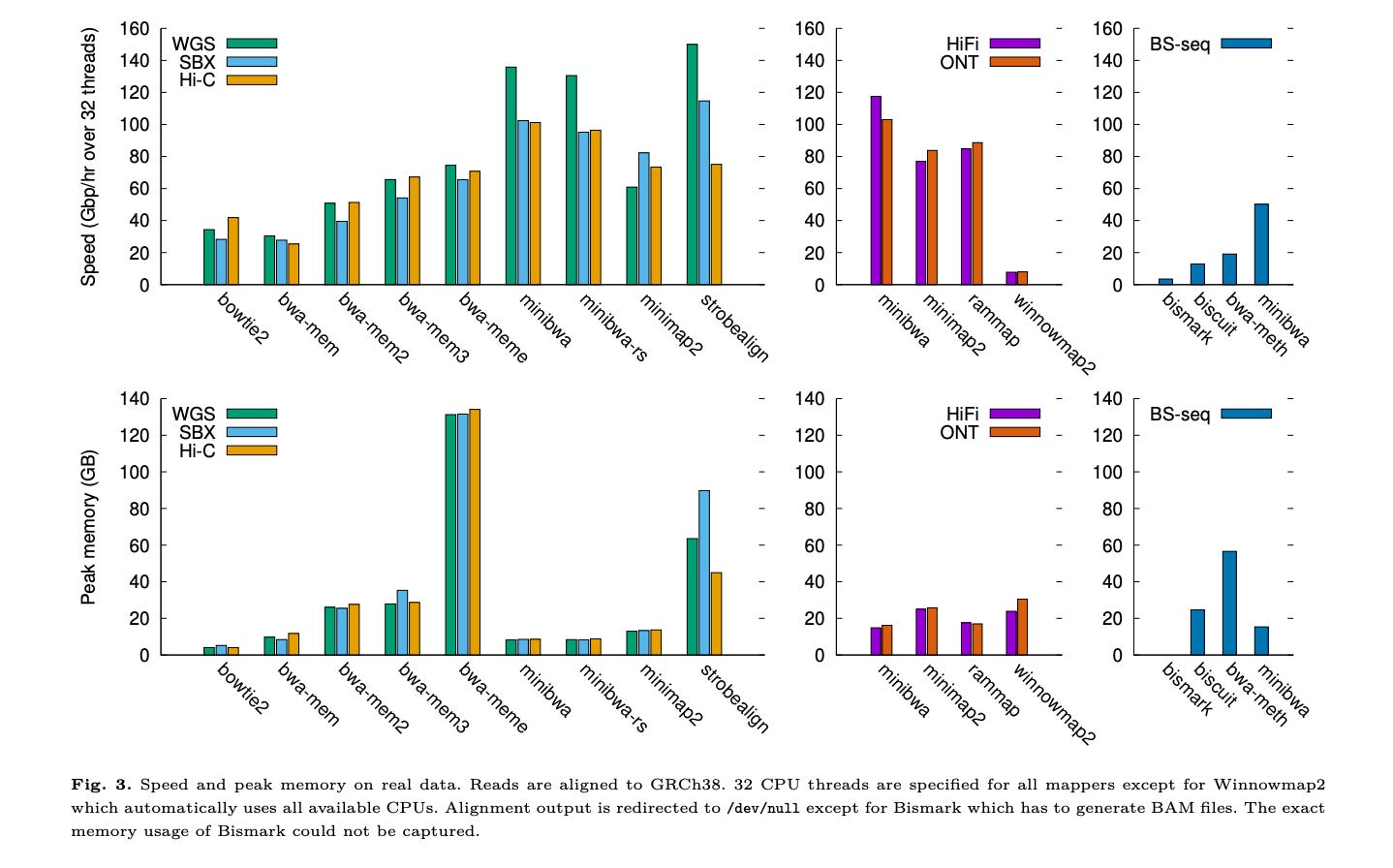
That kind of improvement is important because alignment remains a real cost center in many genomics workflows. In complementary work, we re-wrote fgbio into fgumi finding significant speedups in the fgbio tools (over 25x), finding that now alignment is the dominant bottleneck in the end to end workflow.
Even when it is not the only bottleneck, it is often one of the steps teams have learned to scale around. More cores. More waiting. More Cloud spend. More acceptance that the old path is simply the path.
Minibwa shows that some of that cost is not inherent to the problem. Some of it comes from inherited design choices.
As Nils puts it:
“Every hour and every dollar spent on alignment sits between a sample and an answer. Cutting both reaches the patient, the clinical report, and the researcher.”
Accuracy still has to survive downstream
A faster aligner is useful only if the downstream results hold up.
On simulated WGS short reads, BWA-MEM remains slightly more accurate in some settings, largely because of centromeric and acrocentric regions. Minibwa spends less effort in regions where short reads are often difficult or impossible to place accurately because of repetitiveness and structural variation.
That is the tradeoff, and it’s worth considering for your own pipelines. But we think the better question is whether it changes the outputs users actually care about.
For small variant calling, the reported answer is encouraging.
In the preprint, HG002 short reads were aligned to GRCh38, variants were called with DeepVariant, and results were compared to the GIAB Q100 truth set. Minibwa closely matched or slightly improved on BWA-MEM: fewer SNP false negatives, fewer SNP false positives, fewer indel false negatives, and slightly more indel false positives.
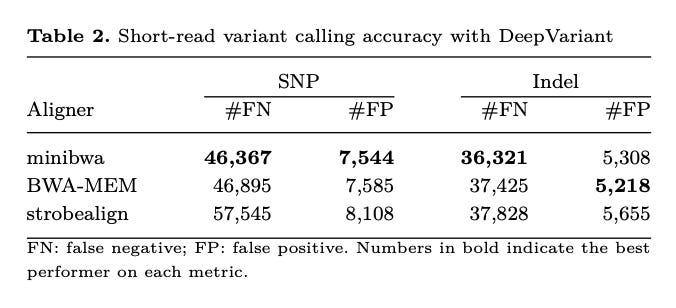
That is the right kind of benchmark. Alignment metrics are informative, but production users need to understand whether changes in mapping behavior affect the calls, reports, and decisions that sit downstream.
The Fulcrum view
At Fulcrum, we care about this category of work because it is highly leveraged.
Most genomics teams do not need novelty for its own sake. They need pipelines that run faster, cost less, behave predictably, and keep up with changes in sequencing technology. Sometimes that means building new methods. Often it means improving the tools people already depend on.
Minibwa fits that pattern. It addresses a real bottleneck, supports multiple read types, reduces unnecessary computation, and evaluates downstream impact instead of stopping at raw speed.
For teams running large-scale WGS, bisulfite sequencing, Hi-C, or mixed read-length workflows, minibwa is worth watching closely — especially where alignment time is starting to shape cost, throughput, or pipeline design.
Read the preprint
The preprint, “Fast genomic read alignment with minibwa,” is available now. The source code is available on GitHub.
Fulcrum Genomics is a bioinformatics consulting firm built by scientists at the forefront of large-scale genomic research, with deep expertise in sequencing technology, pipeline engineering, and genomic data analysis for biotech, pharma, and academia. Engage us through project-based work, fractional R&D, or hourly consulting. Contact us to discuss your project.